
NFL
Supreme Court Tensions Boil Over as Trump Targets Justice Jackson With Impeachment Call Following “Bizarre Tangent” Controversy

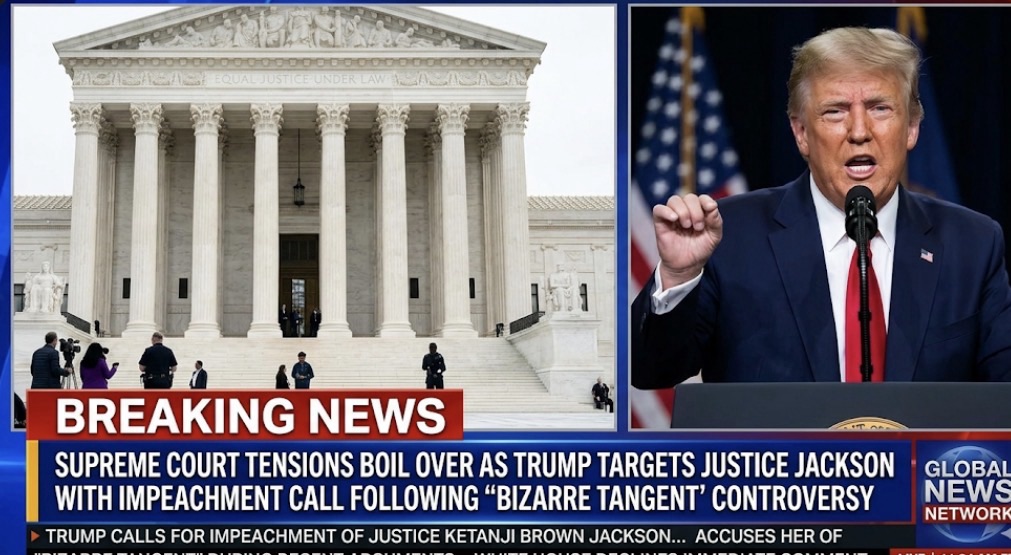
A wave of political controversy erupted following a heated session at the U.S. Supreme Court, as former President Donald Trump publicly called for the impeachment of Justice Ketanji Brown Jackson.The demand came in response to remarks made during oral arguments that Trump and his allies characterized as a “bizarre tangent,” igniting a broader debate about judicial conduct, political pressure, and the boundaries of public criticism of the nation’s highest court.
The courtroom exchange at the center of the storm reportedly unfolded during a complex legal argument, where Justice Jackson posed a line of questioning that diverged from the central issue at hand. While some legal analysts described her comments as a probing attempt to test the limits of the argument, critics seized on the moment as evidence of alleged bias or irrelevance. Within hours, clips and interpretations of the exchange circulated widely, fueling partisan reactions.
Trump responded swiftly and forcefully, issuing a statement accusing Justice Jackson of undermining the integrity of the Court. He argued that her remarks reflected what he called “judicial overreach” and claimed they warranted immediate congressional action. “This is not what the American people expect from a Supreme Court justice,” Trump said, calling on lawmakers to begin impeachment proceedings.
The call has intensified an already charged political atmosphere surrounding the judiciary. Impeachment of a Supreme Court justice is exceedingly rare and historically reserved for cases of serious ethical or criminal misconduct. Legal experts across the ideological spectrum noted that disagreement with a justice’s line of questioning during oral arguments would not typically meet that threshold.
Supporters of Justice Jackson were quick to push back. Many legal scholars and former clerks emphasized that Supreme Court justices often use hypothetical scenarios and unconventional questions to challenge attorneys and clarify legal principles. They argued that isolating a single remark without full context risks misrepresenting the judicial process.
“This is how the Court works,” one constitutional law expert noted. “Justices frequently explore tangents to test the strength of arguments. It’s not evidence of misconduct—it’s part of the job.”
The controversy has also reignited concerns about the increasing politicization of the Supreme Court. Critics warn that calls to impeach justices over disagreements with their judicial approach could erode public confidence in the institution’s independence. Others, however, argue that public scrutiny—even when intense—is a necessary component of accountability in a लोकत्रatic system.
On Capitol Hill, reactions have been divided largely along partisan lines. While some lawmakers aligned with Trump signaled openness to reviewing the matter, others dismissed the impeachment call as politically motivated and lacking constitutional grounding. No formal proceedings have been initiated, and it remains unclear whether the issue will gain any legislative traction.
As the debate continues, the incident underscores the fragile balance between judicial independence and political accountability. With the Supreme Court already at the center of major national debates, the latest clash serves as a reminder of how quickly courtroom dynamics can spill into the broader political arena—reshaping narratives and deepening divisions far beyond the bench.

Trump Declares “Time Is Up” for Pam Bondi as Attorney General Moves to Release Iranian-Hacked Jeffrey Epstein Files Previously Blocked From Public Circulation, Raising Questions About Power Struggles and Political Retaliation

Taylor Swift Spotted Stepping Out in New York City With Kylie Kelce and Jason Kelce, Sparking Rumors as Travis Kelce Is Noticeably Absent From the Outing

Taylor Swift Spotted Stepping Out in New York City With Kylie Kelce and Jason Kelce, Sparking Rumors as Travis Kelce Is Noticeably Absent From the Outing

From “War Is Over” to Mobilization: Trump Orders Immediate Deployment of Ground Troops and Signals New Strikes Against Iran, Leaving Global Leaders Questioning U.S. Strategy

Supreme Court Tensions Boil Over as Trump Targets Justice Jackson With Impeachment Call Following “Bizarre Tangent” Controversy

U.S. Lawmakers Call for Sweeping Investigation Into Donald Trump’s Financial Records Amid Allegations of Attempted Defense Stock Investments Before Iran War Broke Out

Trump Addresses Nation on Ongoing Iran War: Claims Strategic Objectives Nearly Met, Announces Intensified Military Action for Next Two to Three Weeks Despite No Firm End Date

War Will Continue Until Permanent Humiliation and Surrender of the US and Israel, Declares Iran’s Central Military Headquarters in Direct Rebuttal to Trump’s Claims of Destroyed Iranian Forces

President Trump: U.S. Will Launch Extremely Strong Strikes on Iranian Power Plants and Targets in Next 2-3 Weeks, Bringing the Country Back to the Stone Age Where It Belongs

Historic Moment at the Nation’s Highest Court: President Trump Arrives by Limousine, Takes Front-Row Seat for Arguments on His Birthright Citizenship Order, and Exits Before Opposing Arguments Conclude

“No Need for Assassination,” Iranian Officials Declare, Arguing Trump’s Leadership Is Already Accelerating America’s Decline From Within and Undermining Its Global Power
